Where to buy bacteriostatic water in Australia

If you are searching for where to buy bacteriostatic water, start by checking whether the product is legally supplied for your intended use in Australia. Because this product is intended for preparing certain injectable medicines, it is not an ordinary laboratory or household purchase. So, confirm its regulatory status and speak with a pharmacist or doctor before you buy.
This guide explains where to find bacteriostatic water in Australia, how to check a supplier’s claims, and which safety questions matter. It does not recommend using research-labelled products for human or animal treatment.
Where to buy bacteriostatic water in Australia
First, ask your prescribing doctor or pharmacist whether bacteriostatic water is appropriate for the specific medicine you have been prescribed. They can advise whether the medicine requires a diluent and identify the right product and source. In addition, a pharmacist can help check whether a product is available through a legitimate therapeutic-goods supply pathway.
Next, check the product in the Australian Register of Therapeutic Goods (ARTG). The ARTG is the TGA’s public database for therapeutic goods that can be legally supplied in Australia. You can search by product name, sponsor or ARTG identifier, then review the listed formulation and supplier details.
However, not every product that appears in an online search is approved for therapeutic use. Some online listings describe bacteriostatic water as a research chemical or limit it to in-vitro laboratory use. That wording does not establish that the item is suitable for injection or legally supplied as a medicine. So, do not rely on product photos, purity claims, customer reviews or fast-shipping promises as proof of therapeutic approval.
How to check an Australian supplier
Before placing an order, use these checks to assess the supplier and product:
- Confirm the intended use. Ask whether the product is supplied for an authorised therapeutic purpose or strictly for laboratory research.
- Check the ARTG entry. Match the exact product name and sponsor details, rather than relying on a general statement such as “TGA compliant”.
- Ask a pharmacist to verify suitability. The correct diluent depends on the medicine and its approved instructions. Therefore, do not substitute products based on similar labels.
- Review the packaging and documentation. Check for intact seals, clear labelling, batch details, expiry information and storage instructions.
- Avoid products with unclear claims. A certificate of analysis or “sterile” claim on its own does not demonstrate that a product is approved for human injection.
- Do not use research-only products as medicines. A seller’s disclaimer may indicate that its product is not intended for therapeutic use.
If a product is not entered in the ARTG, Australian supply is generally restricted to specific legal pathways, unless an exemption applies. The TGA lists pathways including the Special Access Scheme, Authorised Prescriber Scheme, clinical trials and Personal Importation Scheme. These rules are not a shortcut for commercial sellers to supply unapproved products.
What bacteriostatic water is—and is not
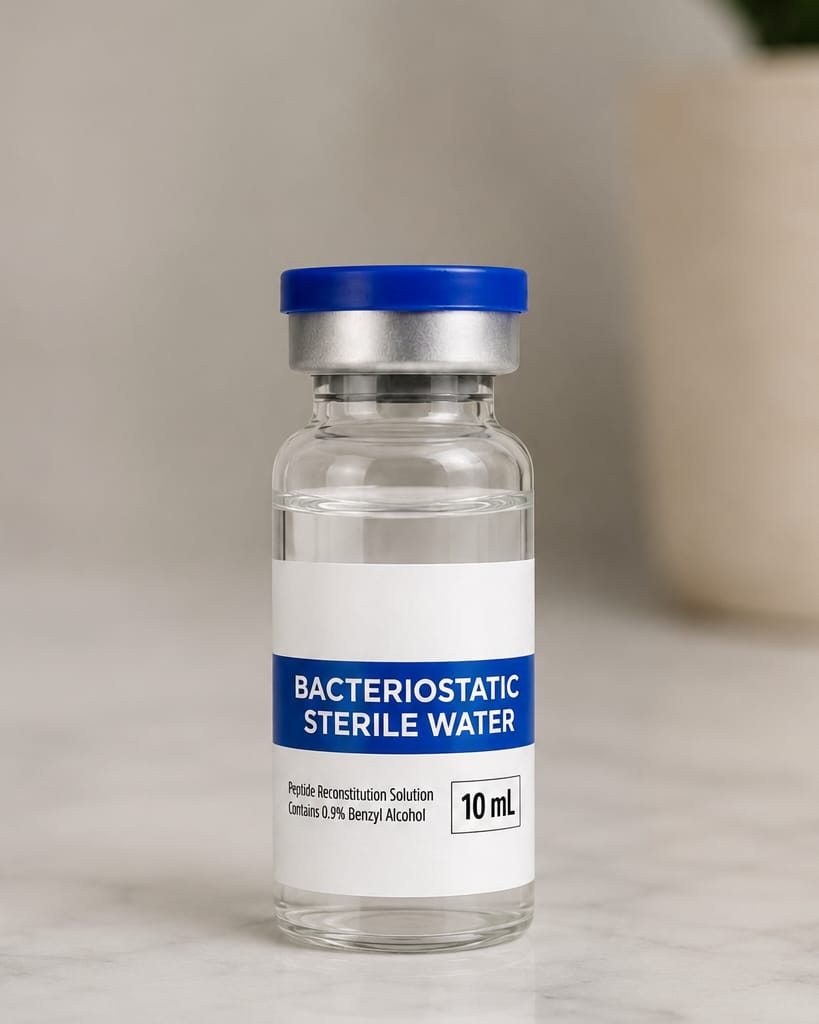
Bacteriostatic Water for Injection is a sterile water preparation containing a preservative, commonly benzyl alcohol. Its labelled medical use is to dilute or dissolve certain medicines for injection, following the specific medicine manufacturer’s directions. It is not a general-purpose hydration product, and it should not be injected on its own.
Importantly, bacteriostatic water is not interchangeable with every type of sterile water or saline. A medicine’s instructions determine which diluent to use, how much to use and how to prepare it. Therefore, ask the prescriber or pharmacist rather than guessing from an online guide.
The preservative also matters. A US product label warns that benzyl-alcohol-containing solutions must not be used in neonates; it also says that preservative-free Sterile Water for Injection should be used when water is needed to prepare or dilute medicines for neonates. This is one reason professional guidance is essential, especially for infants and other people with specific medical needs.
Safer sourcing questions to ask
When you contact a pharmacy, prescriber or supplier, ask direct questions. For example:
- Is this exact product listed in the ARTG, or supplied under a specified legal pathway?
- Is it intended for my prescribed medicine and route of administration?
- Can a pharmacist confirm the correct diluent and preparation instructions?
- What are the product’s storage conditions and expiry details?
- What should I do if the vial is damaged, cloudy or past its expiry date?
These questions help distinguish regulated medicine supply from online listings that may be intended only for laboratory research. They also keep the focus on the medicine’s approved directions, rather than generic advice about mixing or injecting products.
Frequently asked questions
Can I buy bacteriostatic water at any Australian pharmacy?
Availability can vary. Contact a community or hospital pharmacy and provide the exact product and medicine details from your prescription. Then ask the pharmacist whether an appropriate product can be sourced through a lawful supply pathway.
Can I use a research-labelled product for an injection?
No. A product described as “research use only” should not be treated as a medicine for injection. Instead, ask your prescriber or pharmacist to identify an appropriate therapeutic product.
How can I check if a product is approved in Australia?
Search the product name or sponsor in the ARTG database. Review the actual entry and its product details; if you cannot find a matching entry, ask a pharmacist or contact the TGA for guidance.tga.gov+1
Can I import it from overseas?
Some unapproved therapeutic goods may be imported for personal use under the Personal Importation Scheme, but only when the scheme’s conditions are met. It is not permission to resell or supply imported goods to other people. Check the current TGA rules and seek professional advice before ordering.
The safest next step
The practical answer to where to buy bacteriostatic water is: begin with the clinician who prescribed the medicine or a pharmacist, then verify the exact product and its Australian regulatory status. That approach is more reliable than choosing a seller based on price, search ranking or shipping speed. If you are unsure whether a product is suitable, do not use it until a qualified health professional has confirmed the correct option.