
What is hospira bacteriostatic water?

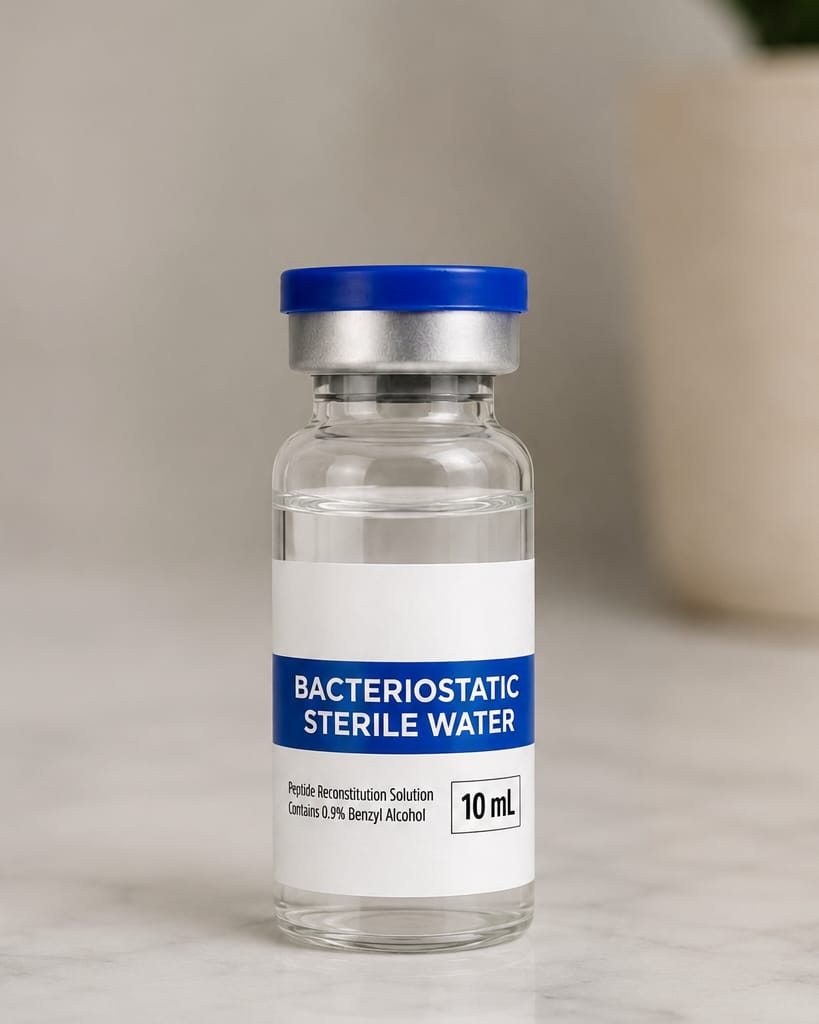
Hospira bacteriostatic water is sterile water for injection that contains a small amount of benzyl alcohol as a preservative. Therefore, it is supplied for specific clinical preparation needs, not as a general-purpose drinking water or household product. In Australia, healthcare professionals should confirm the approved product information, supply status and local requirements before use.
Importantly, bacteriostatic water for injection is intended to dilute or dissolve a compatible injectable medicine when its instructions allow it. However, it is not automatically suitable for every medicine, patient or injection route. The correct diluent depends on the medicine’s formulation, concentration, route and manufacturer guidance. Consequently, a qualified clinician or pharmacist should make the final decision.
Hospira bacteriostatic water for injection: how it differs
The word “bacteriostatic” describes the preservative’s ability to limit bacterial growth. This applies after controlled container entry. However, the preservative does not make poor handling safe. It also does not replace aseptic technique or make contaminated solution safe.
By comparison, sterile water for injection without a preservative may come in a single-dose format. In contrast, Hospira multi-dose bacteriostatic water may support repeated withdrawals. This depends on the label, facility policy and applicable rules. Always check the container label because presentations can vary.
Hospira bacteriostatic water: clinical purpose and compatibility
Before a clinician uses bacteriostatic water from Hospira, review the medicine’s official instructions. In addition, check compatibility, stability, concentration and route requirements. Some medicines require a particular diluent. Others may be damaged by preservatives or pH changes.
For this reason, never select a diluent based only on a similar product name or an online description. Instead, consult the medicine’s Australian Product Information, a hospital protocol or a registered pharmacist. Furthermore, the prepared solution should be labelled and handled according to the relevant clinical process.
Who needs additional clinical caution?
Hospira preserved sterile water contains benzyl alcohol. Therefore, it may not suit some newborns, infants, pregnant patients or people with sensitivity. It may also pose risks for some clinical conditions. A qualified healthcare professional must decide suitability.
In addition, the product is not interchangeable with every preserved diluent or sterile diluent. Discuss allergies, liver concerns, kidney concerns or complex medicines before preparation. When uncertain, pause and seek professional advice rather than relying on a search result.
Storage, packaging and handling basics
Correct storage helps protect product quality. Accordingly, users should follow the manufacturer’s labelled temperature, light and handling instructions. The container should be inspected before use for damage, leaks, particles, cloudiness or an unusual appearance. If anything appears abnormal, the product should be quarantined and assessed by a healthcare professional.
After opening, the container must be handled within the timeframe and conditions stated in the official instructions. Although a preserved product can support multiple withdrawals, it is not an unlimited-use container. Each entry should use appropriate aseptic technique, a new sterile needle and a clean access point, as required by the facility’s policy.
Hospira bacteriostatic water: common questions
People often search for Hospira bacteriostatic water to identify a product or compare presentations. Nevertheless, online availability does not prove that a product is genuine or authorised. It also does not prove suitability for a particular medicine. Buyers should use an established pharmacy or authorised supplier.
Before ordering, check the exact product name, concentration, preservative, container size, expiry date and storage conditions. Also, confirm whether the item is available and approved for the intended Australian setting. A pharmacist can help distinguish Hospira bacteriostatic water for injection from similarly named products.
Choosing information about bacteriostatic water from Hospira
Reliable information should come from the product label, official manufacturer documentation, the Australian Register of Therapeutic Goods where relevant, and qualified healthcare professionals. In addition, a trustworthy page should explain what the product is not: it is not a substitute for medical advice, not a universal diluent and not a product for self-injection decisions.
For searchers, clear navigation is useful. Start with the product identity, then review the intended purpose, compatibility warnings, preservative information and storage guidance. Finally, confirm the advice with a pharmacist or clinician before any preparation or administration.
Safety checklist for healthcare settings
Before use, confirm the following points:
•Product identity: Match the name, preservative and container presentation with the approved instructions.
•Medicine compatibility: Check the medicine’s official information and the required diluent.
•Patient suitability: Consider age, allergies, pregnancy and relevant clinical conditions.
•Container integrity: Reject containers that are damaged, leaking, cloudy or contaminated.
•Aseptic handling: Follow local infection-control procedures and facility policy.
•Traceability: Record the product and preparation details as required by the clinical setting.
This checklist supports safer decision-making. However, it does not replace a pharmacist’s or clinician’s assessment.
Final guidance on hospira bacteriostatic water
Hospira bacteriostatic water can be relevant when a compatible injectable medicine requires a preserved sterile diluent. Even so, the correct product, route and handling process must always be confirmed professionally. Product labels and local Australian requirements should take priority over general online content.
If you are comparing Hospira multi-dose bacteriostatic water with another sterile diluent, ask a registered pharmacist to explain the differences. As a result, you can verify the preservative, compatibility, storage and supply details before proceeding. For patient safety, do not prepare or administer an injectable medicine without appropriate clinical training and authorisation.
Medical information notice: This article is for general education and search guidance only. It does not provide instructions for self-injection, diagnosis or treatment. Always follow the current official product information and obtain advice from a qualified Australian healthcare professional.