GLOW Peptides
Understanding the Core Components
The Glow Peptide typically combines GHK-Cu, BPC-157 and TB-500. GHK-Cu is a copper-binding tripeptide that occurs naturally in plasma. Meanwhile, BPC-157 is a stable 15-amino-acid sequence studied in injury models. In addition, TB-500 is a synthetic fragment of thymosin beta-4 linked to cell migration.
Consequently, the Glow peptide blend offers a single-vial approach for laboratory investigation of complementary mechanisms.
How the Mechanisms Interact
GHK-Cu modulates gene expression related to the extracellular matrix. Therefore, studies focus on collagen and elastin pathways. At the same time, BPC-157 receives attention for angiogenesis and cytoprotective signalling. Furthermore, TB-500 supports actin regulation and cellular movement in wound models.
As a result, the Glow peptide stack allows researchers to explore sequential repair stages without separate administrations.
Research Focus on Skin and Matrix Remodelling
Laboratory work highlights GHK-Cu for fibroblast activity and glycosaminoglycan synthesis. In parallel, the radiance peptide combination draws interest because of observed effects on matrix organisation in cell culture.
However, most human data for GHK-Cu come from topical applications rather than injectable forms.
Tissue Models and Preclinical Observations
Animal and in-vitro studies examine BPC-157 in tendon and soft-tissue contexts. Likewise, TB-500 features in re-epithelialisation assays. Together these form the basis of interest in the tissue recovery peptide mix.
Nevertheless, no published clinical trials evaluate the complete blend itself.
Standard Composition Notes
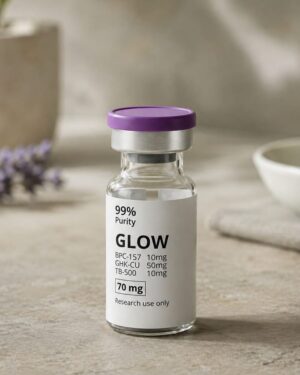
A common research presentation totals approximately 70 mg. Typically this includes about 50 mg GHK-Cu, 10 mg BPC-157 and 10 mg TB-500. Researchers reconstitute the lyophilised material under controlled conditions and document batch-specific purity.
Practical Considerations for Laboratory Use
Certificates of analysis and third-party testing remain essential. Moreover, storage after reconstitution requires refrigeration and protection from light.
Distinctions from Related Formulations
Some suppliers offer an expanded version that adds a fourth peptide. In contrast, the standard Glow peptide blend remains limited to the three core compounds.
Evidence Limitations and Context
Current literature rests on individual-component studies. Therefore, claims about combined outcomes stay extrapolative. In addition, regulatory status varies by jurisdiction and none of the constituents holds approval as an injectable cosmetic or therapeutic product in most regions.
Broader Scientific Interest
Interest continues because the compounds address different phases of tissue response. Collagen pathways, vascular support and migratory signalling each receive separate scrutiny. Consequently, the Glow Peptide serves as a convenient research tool rather than a single molecule.
Summary of Key Pathways
- GHK-Cu – matrix remodelling and gene modulation
- BPC-157 – local repair signalling
- TB-500 – cell migration and actin dynamics
Overall, the Glow peptide stack illustrates how researchers combine complementary signals for multi-pathway investigation.
Showing the single result
-
Glow peptide
$115.00